
🔥 News
- 2026.09: 🎉 Our paper “Estimating and Predicting Clinical Trial Outcomes in China” is accepted by Drug Discovery Today!
- The paper is now published online: [PDF] [Appendix] [Journal].
- Around a quarter of drug development now has a Chinese origin, yet China-specific success benchmarks and forecasting tools remain scarce. We analyze all non-generic drug trials registered on China’s national drug clinical trial registry from 2013 to 2025, benchmark phase-transition probabilities of success (PoS)—where success denotes a program advancing to the next phase or to approval—and forecast trial outcomes with machine learning using structured registry features and Chinese text. China’s overall Phase I-to-Approval PoS is below 30% across most therapeutic areas, while Phase II-to-Phase III transition rates run far above global benchmarks. In out-of-sample evaluations, random forests reach AUCs approaching 80% and logistic regression around 70%, with the sponsor’s track record and text-derived signals as key drivers.
- 2026.03: 🎉 Our paper “The Health of Nations Fund: Financing Global Drug Development” is accepted by PLOS Global Public Health!
- The paper is now published online: [PDF] [Appendix] [Journal].
- We explore the design and performance of a “Health of Nations Fund,” a proposed securitization of a biomedical “megafund” that pools capital to invest in a diversified set of global drug development projects. Incorporating assets from four stages of the drug development process as well as royalties from approved therapeutics across eight therapeutic areas, our Monte Carlo simulations show that such a megafund can deliver an annual expected return of 12.0% with a Sharpe ratio of 1.37, indicating a favorable balance between risk and return. At the same time, it finances an average of 25 approved drugs that potentially benefit approximately 44 million patients worldwide over 15 years. To enhance the fund’s financial and therapeutic value, we integrate an optimization framework into our design that accounts for global disease prevalence and severity, allowing investors to adjust the allocation of capital according to their preferences for financial performance and healthcare impact. Sensitivity analyses indicate that this megafund typically generates double-digit annual returns across most scenarios.
- 2026.02: Our paper “Underperformance of Performance Shares” is now on [SSRN]. Comments and suggestions are welcome.
- We explore whether firms using performance share units (PSUs) as part of their executive compensation packages deliver better shareholder returns. Using an instrumental variable design that leverages compensation consultant-driven adoption, we find that firms with a PSU in effect perform more poorly than non-PSU firms. Firms that rely more heavily on PSUs as a proportion of total compensation perform especially poorly. In contrast, time-vesting equity sees no underperformance, indicating the effect is not a generic long-term incentive issue. We also find that design choices matter: PSUs that vest on earnings per share (EPS) accounting targets underperform other plan designs. The underperformance is more pronounced when institutional ownership is higher, particularly those institutions that almost always vote with proxy advisors. This is consistent with the hypothesis that proxy advisors (such as ISS) pressure firms to adopt PSUs. The aggregate evidence suggests prevalent PSU practices can weaken pay-performance alignment and should inform policy debates on proxy advisor recommendations and incentive design.
- 2025.09: Our paper “Optimal Multi-Period Dynamic Portfolios for Sustainable Investing” is now on [SSRN]. Comments and suggestions are welcome.
- We develop a stochastic control framework for constructing optimal multi-period dynamic ESG portfolios, in which investors form dynamic portfolios by maximizing utility functions that account for both profitability and the average ESG scores of their portfolios in the near and distant future. We provide an explicit solution to the investors’ utility maximization problem, and show that the optimal weight is a linear combination of three components: a financial performance component, an ESG component, and a component reflecting the weight from the previous period. Using the U.S. stock market data, we find that the multi-period dynamic ESG portfolio outperforms single-period portfolios in terms of returns, Sharpe ratios, alphas, and information ratios.
- 2025.08: 🎉 Our paper “The Evolution of Discrimination Under Finite Memory Constraints” is accepted by Scientific Reports!
- This paper is now published online: [PDF] [Appendix] [Journal].
- We develop an evolutionary model for individual discriminatory behavior that emerges naturally in a mixed population as an adaptive strategy. Our findings show that, when individuals have finite memory and face uncertain environments, they may rely on prior biases and observable group traits to make decisions, leading to discriminatory practices. We also demonstrate that a finite memory is a consequence of natural selection because it leads to higher fitness in dynamic environments with mutations.
-
2025.05: Our paper “On Consistency of Signature Using Lasso” has been reported by Center for Statistical Science, Peking University.
- 2025.03: 🎉 Our paper “On Consistency of Signature Using Lasso” is accepted by Operations Research!
- This paper is now published online: [PDF] [Appendix] [Journal].
- We study the statistical consistency of signature using Lasso regression, both theoretically and numerically. We demonstrate that the signature can be applied to learn nonlinear functions and option prices with high accuracy, and the performance depends on properties of the underlying process and the choice of the signature.
- 2025.01: 🎉 Our paper “The Checkerboard Copula and Dependence Concepts” is accepted by SIAM Journal on Financial Mathematics!
- This paper is now published online: [PDF] [Journal].
- We study the problem of choosing the copula when the marginal distributions of a random vector are not all continuous. We show that the checkerboard copula (the unique copula with a distribution that is as uniform as possible within regions of flexibility) has the largest Shannon entropy, which means that it carries the least information among all possible copulas for a given random vector. Furthermore, the checkerboard copula preserves the dependence information of the original random vector, leading to two applications in the context of diversification penalty and impact portfolios.
- 2025.01: 🎉 Our paper “High-Frequency Liquidity in the Chinese Stock Market: Measurements, Patterns, and Determinants” is accepted by Pacific-Basin Finance Journal!
-
2024.09: 🎆 I am enrolled as a Fellow of the Society of Actuaries (FSA)!
- 2024.07: 🎆 I am honored to receive the Outstanding Doctoral Dissertation Award of Peking University!
- This is reported by School of Mathematical Sciences, Peking University.
- 2024.04: 🎆 I am enrolled as a Postdoctoral Associate at MIT Sloan School of Management.
- 2024.03: Our paper “Optimal Impact Portfolios with General Dependence and Marginals” has been reported by Center for Statistical Science, Peking University.
- 2024.02: 🎉 Our paper “Optimal Impact Portfolios with General Dependence and Marginals” is accepted by Operations Research!
- This paper is now published online: [PDF] [Appendix] [Journal].
- We characterize the distribution of induced order statistics for general dependence and general marginals of any bivariate random variables, which is used to construct optimal impact portfolios.
- I won second place in the Best Paper Prize for Young Scholars at the Annual Conference of the Operations Research Society of China (Financial Engineering and Risk Management Branch) in 2023.
- 2024.01: I receive my Ph.D. degree in Statistics from Peking University! I am expected to be a Postdoctoral Associate at MIT Sloan School of Management in this year.
- I completed my Ph.D. six months ahead of schedule.
- It is my honor to be a Beijing Outstanding Graduate in Spring 2024.
- 2023.12: I successfully pass my Ph.D. thesis defense!
- The title of my Ph.D. thesis (in Chinese) is “Stochastic Models and Statistical Analysis for High-dimensional Multi-factor Models and Induced Order Statistics” (高维多因子模型与伴随次序统计量的随机模型与统计分析).
- I am also happy to be the first student to defend my thesis in Zhihua Building, the new building of Peking University School of Mathematical Sciences.
With Prof. Lan Wu  |
With Prof. Ruixun Zhang 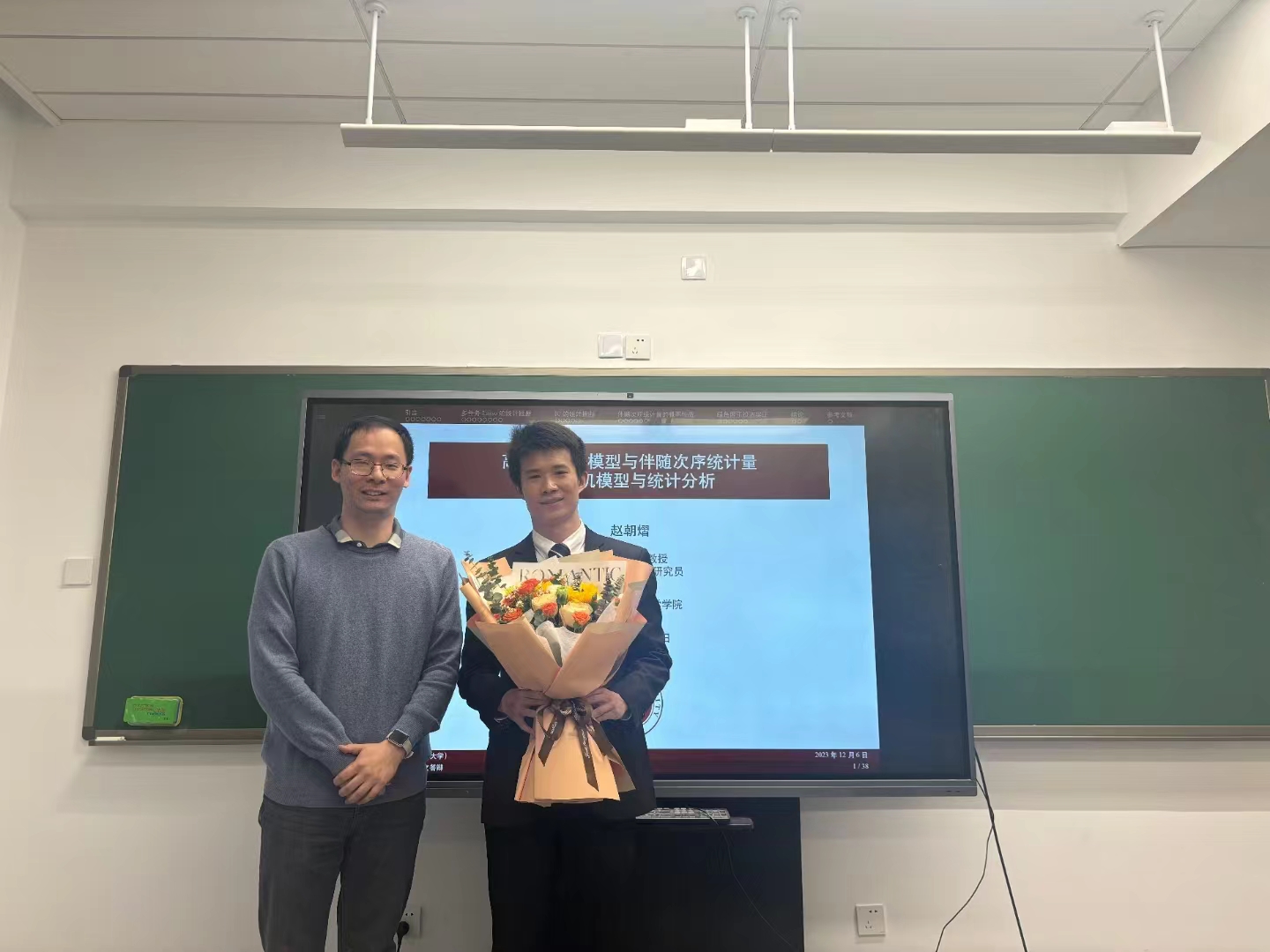 |
- 2023.11: 🎉 Our paper “Construct Smith-Wilson Risk-Free Interest Rate Curves with Endogenous and Positive Ultimate Forward Rates” is accepted by Insurance: Mathematics and Economics!